

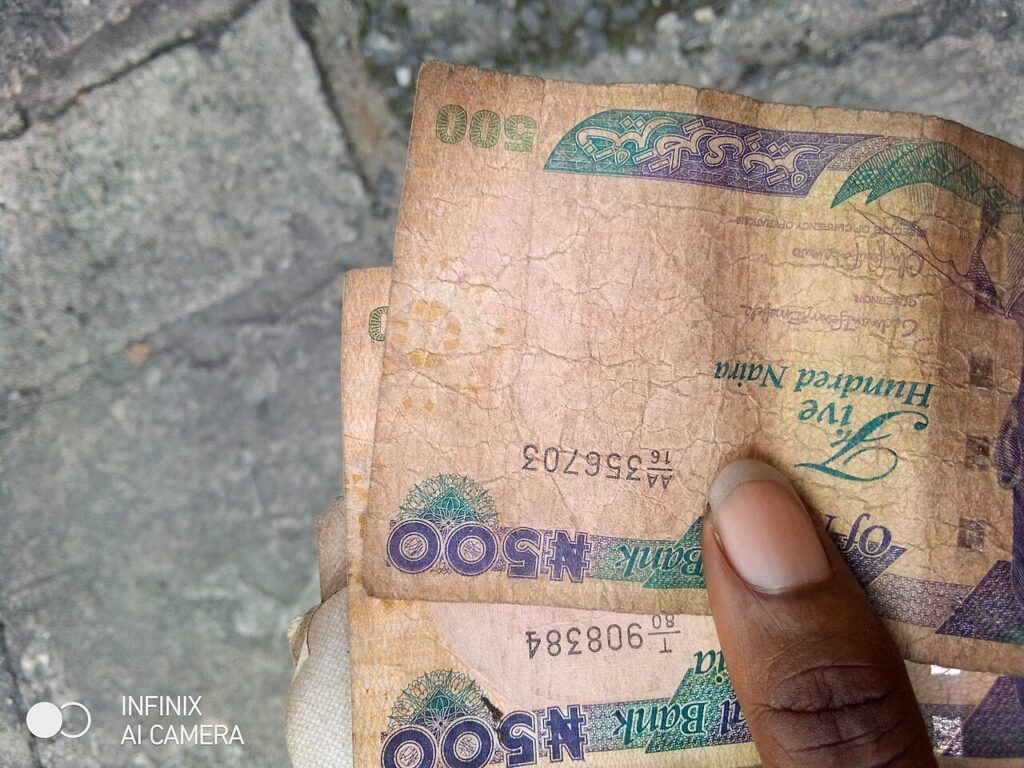
The naira to dollar rate closed at ₦1,348 on Wednesday, 4 November 2026, in the official Nigerian Foreign Exchange Market (NFEM). That was 25 kobo weaker than Tuesday’s ₦1,347.75, the second fall in a row. It came the same day a study in a Central Bank of Nigeria (CBN) journal named government budget deficits as a main cause of the naira’s long slide.
Why it matters: A weaker naira makes imported food, fuel, drugs and school fees paid in dollars cost more, and the study says government borrowing is part of the reason.
Key facts at a glance
- Official close on 4 November: ₦1,348/$, down 0.02% from ₦1,347.75/$.
- The rate moved between ₦1,346 and ₦1,349.50 during the day.
- Parallel (street) market: ₦1,377/$ on 4 and 5 November, about ₦29 weaker than the official rate.
- Gross external reserves: $55.150bn on 3 November, from $55.168bn a day earlier.
- The CBN study used yearly data from 1981 to 2024.
How did the naira to dollar rate move this week?
The naira opened November at ₦1,346.01/$ and has lost ground every day since 3 November. The weighted average rate on 4 November was ₦1,347.80.
Trading also thinned. Interbank data showed 97 deals worth about $100.93m on 4 November, down from 117 deals worth $118.96m on Tuesday. The CBN had not yet released its official turnover for the day.
The naira was at ₦1,329.50/$ at the end of September. By 30 October it had slipped to ₦1,346, giving back about 42% of the gains it made between July and September, Nairametrics calculated.
What did the CBN study find?
The paper, “Budget Deficit Dynamics and Macroeconomic Performance in Nigeria”, was written by Ndubuisi E. Uguru and published in the CBN Journal of Applied Statistics. It uses a statistical model that tracks how several economic measures affect each other over time.
It found that “budget deficits are a primary driver of exchange rate depreciation”. Deficits also push up interest rates, but only after a delay.
The study found “no statistically significant direct link between budget deficits and inflation”. It put price rises down more to supply problems, structural bottlenecks and the knock-on effect of a weaker naira on import prices.
The author calls the pattern fiscal dominance. That means government spending pressure weakens the currency and limits how freely the central bank can set policy.
What does the study recommend?
- A legal cap on the budget deficit as a share of GDP (gross domestic product, the size of the economy).
- A non-oil Fiscal Stabilisation Fund and incentives for local production.
- A clear framework for the CBN and the finance ministry to work together, so the bank does not have to tighten money supply suddenly.
Background: how big is the deficit?
- December 2025: President Bola Tinubu presents a 2026 budget with a proposed ₦23.85trn deficit.
- April 2026: Planned federal borrowing for 2026 rises to ₦29.20trn after the budget size and deficit go up.
- July 2026: The CBN’s Monetary Policy Committee (MPC, which sets the benchmark interest rate) holds the rate at 26.5%.
- September 2026: The MPC cuts the rate by 3.5 percentage points to 23%, its largest cut since December 2006.
- 4 November 2026: The naira closes at ₦1,348/$.
What it means for you
Anyone who pays for goods, travel or tuition in dollars pays more when the naira slips, and the study points to the exchange rate as one route by which higher import costs reach prices. Buyers on the street market paid about ₦29 more per dollar than the official rate this week.
If the study is right, bigger deficits now mean more pressure on the naira later, which matters as the Senate weighs new foreign loans for the 2026 budget.
What happens next
The CBN publishes official NFEM turnover and reserves figures daily. The MPC’s next decision on interest rates will show whether it sees room to keep cutting.
FAQ
What is the official naira to dollar rate? It is the rate in the NFEM, where banks and the CBN trade dollars. It closed at ₦1,348/$ on 4 November 2026.
Why is the street rate higher? The parallel market is where bureaux de change and individual dealers trade cash dollars outside the official window. On 4 and 5 November it was ₦1,377/$.
Does the CBN study say deficits cause inflation? No. It found no statistically significant direct link between deficits and inflation over 1981 to 2024, though it did link deficits to a weaker naira.
Related coverage
- Tinubu loan request: Senate asked to approve $7.7bn for 2026 budget
- Nigeria external debt rises to $145bn in 2025, World Bank says
This article is for information only and is not financial advice.
Sources: Nairametrics – Naira slips to ₦1,348/$ as FX turnover drops · Nairametrics – Budget deficits fuelling naira depreciation, CBN study finds · Arbiterz – Dollar to naira rate, 5 November 2026


Join the conversation
Comments are moderated. Keep it respectful and on topic: no insults, hate, spam or personal details.