

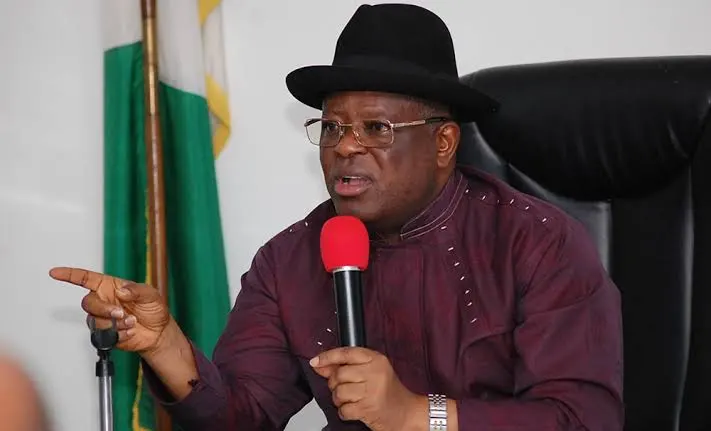
There is an old saying that has become a staple of modern discourse: “When someone shows you who they are, believe them the first time.”
In May 2025, Nigeria witnessed a viral moment involving the Minister of Works, Dave Umahi, and the then newly appointed Minister of State for Foreign Affairs, Bianca Ojukwu .
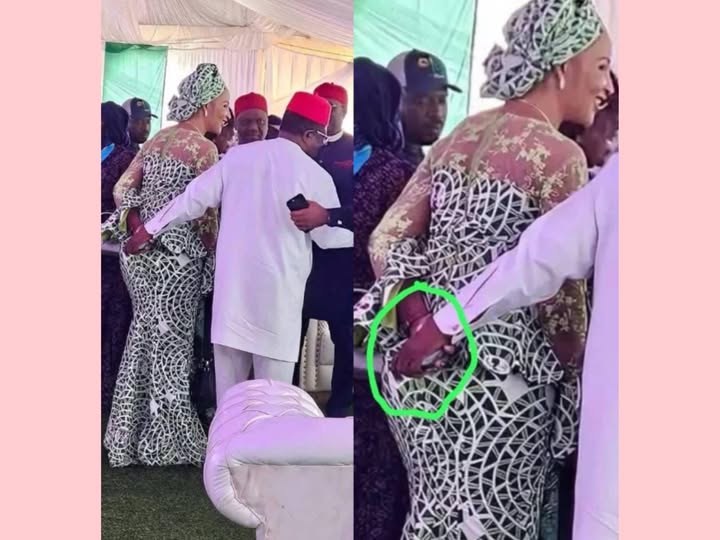
At a formal public function, a video captured the Minister of Works attempting to place his hand on the waist/back of Mrs. Ojukwu. What followed was telling: Mrs. Ojukwu, a diplomat and a woman of immense poise, was seen calmly but firmly stopping his hand . She didn’t make a scene. She didn’t shout. She simply enforced her boundary with grace and moved on.
Many of us watched that video and laughed it off as an awkward moment or a “harmless” mistake. We applauded Bianca for her composure.
But here is the question we didn’t ask loudly enough: Was that truly an isolated accident in May 2025, or was it a glimpse of a deeper disposition?
The Question of Boundaries
Ministers are colleagues. They are members of the Federal Executive Council, bound by protocols of professional conduct. Bianca Ojukwu is not just “any woman”; she is a senior official of the Nigerian state, a widow, and a representative of the country on the diplomatic stage .
If, in the full glare of cameras and protocol officers, a man in power feels entitled to cross a physical boundary with a female colleague, what happens when the cameras are off? What happens when the woman doesn’t have the public stature of Bianca Ojukwu to defend herself?
At the time, human rights lawyer Chidi Odinkalu aptly commented that Umahi was caught on camera as “Minister for Wandering Fingers” . It was a remark many dismissed as mere banter.
This brings us to the troubling case of Tracy Nicolas Ohiri.
Fast forward to February 2026. The nation witnessed another scene at the Force Headquarters in Abuja. Activist Omoyele Sowore confronted Minister Umahi inside a police facility over the detention of a businesswoman, Tracy Ohiri.
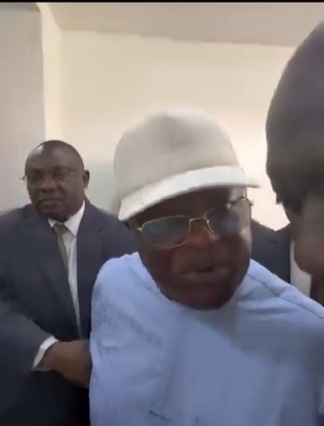
Ohiri alleges that Dave Umahi owes her ₦304 million for services rendered during his 2015 governorship campaign. She claims that when she pushed for payment, the conversation shifted from business to a demand for a “personal relationship.” According to her testimony, her refusal was met with threats and ultimately, her arrest on charges of cyberbullying when she dared to speak up.
Connecting the Dots
We must look at these two incidents side by side.
In the first incident (Ojukwu, May 2025), we see a man who, in a public setting, physically reaches for a woman who did not invite his touch. The woman, because of her status, was able to stop him without consequence.
In the second incident (Ohiri, February 2026), we see a businesswoman who allegedly faced police detention because she refused a similar dynamic.
And remarkably, reports have emerged that Ohiri is “not the only Umahi victim.” Other women have reportedly come forward with similar accounts of harassment and unpaid debts.
A Pattern of Power Dynamics
This isn’t just about a wandering hand. It is about a mindset. It is a mindset where a man in power views the women around him—whether colleagues, contractors, or entrepreneurs—as subjects of his pursuit rather than professionals deserving of respect.
It suggests a confusion between “power” and “privilege.” Just because you hold a ministerial seat does not mean you hold a claim over the women who share the room with you or who depend on you for payment.
If in May 2025 you were willing to reach for a minister beside you, it is not a leap to believe that by February 2026 you would pressure a contractor relying on you for survival.
The Verdict of the Public
We must move beyond tribal defenses or party loyalty. Whether it is Bianca Ojukwu’s waist in a boardroom or Tracy Ohiri’s business contract, the principle is the same: No woman in Nigeria should have to trade her dignity for her dues or her peace.
Dave Umahi has denied the allegations from Ms. Ohiri, calling them politically motivated. He is entitled to his day in court. However, the visual evidence of the Ojukwu incident from May 2025 is undeniable.
That video was not “political.” It was behavioral.
To the Minister of Works, I say this with respect: Leadership is not just about building roads; it is about building trust. When you touch a woman without her consent, even in a moment you deem casual, you tell every woman watching that your impulse outweighs their autonomy.
When a man is labeled “Minister for Wandering Fingers” in May 2025, and by February 2026 is facing multiple allegations of harassment and intimidation, it ceases to be a coincidence—it becomes a pattern.
Let that May 2025 video serve not as a meme, but as a mirror. What it reflects is a man who still needs to learn that the office he holds demands more than technical competence—it demands character.
What do you think? Is this a fair observation of a pattern, or are we reading too much into these incidents?













Nonsense set of people that uses power to oppress and get people intimidated