

The Central Bank of Nigeria (CBN) has issued its first full rulebook for stablecoins and crypto service firms. Under the new CBN stablecoin rules, a company issuing a naira-backed token needs ₦10 billion in paid-up capital, and one issuing a dollar-linked token needs ₦15 billion.
The 169-page Regulations for the Operations of Non-Security Virtual Assets in Nigeria came with a circular dated 5 November 2026 (reference PSP/DIR/PUB/CIR/001/004). It was signed by Musa Jimoh, Director of the CBN’s Payments System Policy Department.
Why it matters: Many Nigerians use dollar stablecoins such as USDT to save, trade and receive money from abroad. The platforms they use now need a CBN licence, and foreign issuers get no exemption.
Key facts at a glance
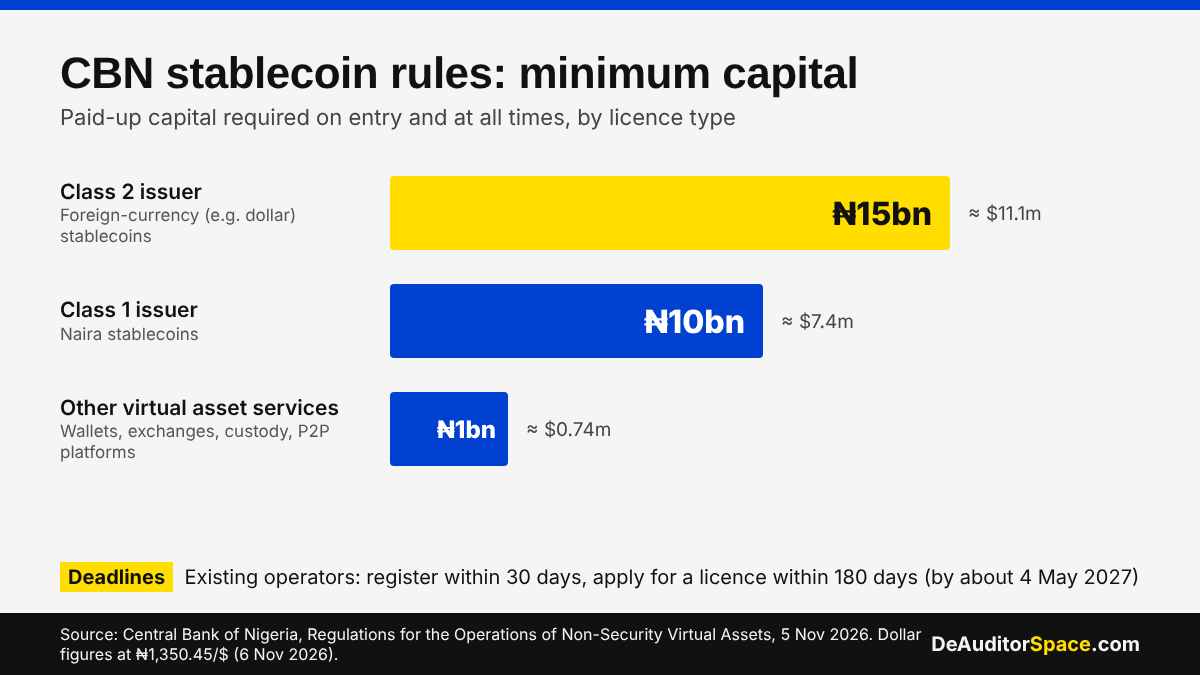
- Naira stablecoin issuers (Class 1): minimum paid-up capital of ₦10 billion.
- Foreign-currency stablecoin issuers (Class 2): ₦15 billion.
- Other crypto service providers, such as wallets and exchanges: ₦1 billion.
- Existing operators must register within 30 days and apply for a licence within 180 days.
- Stablecoins may not be presented as bank deposits or as insured by the NDIC (Nigeria Deposit Insurance Corporation).
What are the new CBN stablecoin rules?
A stablecoin is a digital token built to hold a steady value against a currency, usually the naira or the US dollar. The rules set up a licensing and supervision system for stablecoins, Deposit Money Tokens (digital versions of bank deposits) and virtual asset service providers, or VASPs.
“Non-security” means tokens that are not investment products. Crypto assets treated as securities stay with the Securities and Exchange Commission (SEC).
In the document’s introduction, the CBN said virtual assets offer “significant opportunities” for payments, remittances and digital commerce. It added that their growing use also brings risks to financial stability, monetary policy, consumer protection and foreign exchange management.
How much capital do stablecoin issuers need?
The capital must be held “on entry and at all times thereafter”, and the CBN may demand more. At the official rate of ₦1,350.45 to the dollar reported on 6 November, ₦15 billion is about $11.1 million. ₦10 billion is about $7.4 million, and ₦1 billion is about $740,000.
Naira stablecoins must be backed by naira reserve assets. The rules list short-dated Treasury bills, Federal Government bonds maturing within 180 days and naira cash held in separate reserve accounts at licensed commercial banks.
Can foreign firms still offer USDT and USDC to Nigerians?
Not without a Nigerian licence. The rules cover any regulated activity carried out in Nigeria, from Nigeria, or “directed at persons in Nigeria”.
A foreign-currency stablecoin may be offered, traded, held or redeemed for people in Nigeria “only as a Class 2 Stablecoin issued through a Nigerian-incorporated entity” with the CBN’s foreign currency issuer licence. A foreign licence or an arrangement with a Nigerian partner “shall not substitute” for that licence, the regulations state.
Section 15 of the rules is blunt: “There is no offshore issuer exemption from incorporation, licensing or capital.”
What changes for P2P crypto traders?
Peer-to-peer (P2P) trading, where users buy and sell crypto directly with each other through an app, is not banned. Platforms that hold tokens in escrow or connect buyers and sellers now fall under the rules.
Vanguard reported that providers must set board-approved tests to spot customers who trade crypto as a business. The tests look at trading volumes, how often a person trades, the number of counterparties and whether they advertise exchange rates. Such customers face extra checks and transaction limits, and must be reported to the CBN.
Amina Ibrahim, a fintech expert quoted by BusinessDay, said users “should expect stronger identity checks, clearer disclosures and closer monitoring of transactions”.
Background: how Nigeria got here
- February 2021: The CBN told banks to stop serving crypto exchanges and close linked accounts.
- December 2023: The CBN lifted that restriction and allowed banks to open accounts for SEC-licensed VASPs.
- March 2025: President Bola Tinubu signed the Investments and Securities Act 2025, which brings digital assets treated as securities under the SEC.
- August 2026: The CBN opened its regulatory sandbox (a supervised testing scheme) to virtual asset firms, with a track for stablecoins and wallets.
- 5 November 2026: The CBN issued the new virtual asset regulations.
What it means for you
If you hold USDT or another dollar token on a local app, nothing in the rules stops you from owning it. The platform will need a licence, and you should expect more requests for identity documents and closer checks on large or frequent trades.
A CBN licence is not a guarantee. The rules bar firms from presenting a licence or token approval as a CBN endorsement, and no stablecoin is covered by NDIC deposit insurance.
What happens next
Existing operators must register with the CBN within 30 days, by about 5 December 2026. They must begin supervisory reporting within 60 days, around 4 January 2027, and file a full licence application within 180 days, by about 4 May 2027.
Until then they may operate only at their current scale. A firm that misses the deadline must stop until it is licensed.
Related coverage
- Crypto tax in Nigeria: how the 2026 tax laws treat your gains
- Naira exchange rate explained: how the official rate is set
- Bitcoin price falls below $80,000
This article is for information only and is not financial advice.
Sources: CBN – Regulations for the Operations of Non-Security Virtual Assets in Nigeria (PDF) · CBN – Circulars · Vanguard – CBN sets N10bn, N15bn capital requirements · BusinessDay – What CBN’s new crypto rules mean for you · Nairametrics – Naira at NFEM · Techpoint – CBN lifts crypto ban · TechAfrica News – CBN opens regulatory sandbox


Join the conversation
Comments are moderated. Keep it respectful and on topic: no insults, hate, spam or personal details.