


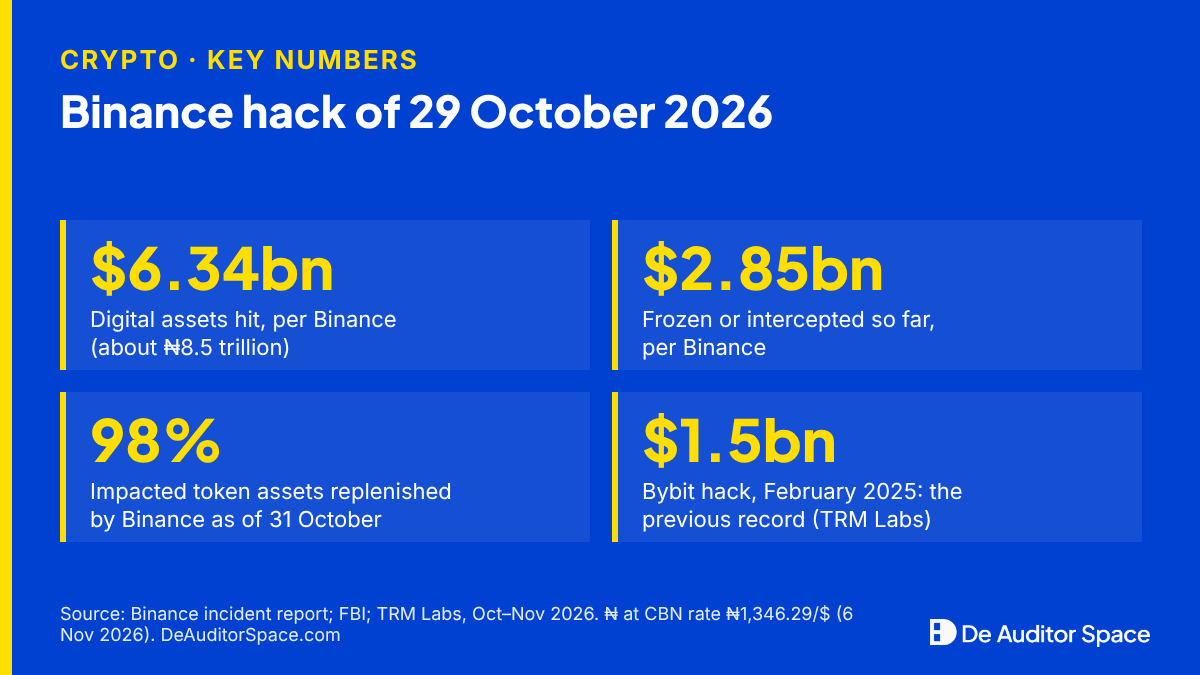
The Binance hack that drained about $6.34 billion from the world’s largest crypto exchange on 29 October began months earlier with a fake job interview, according to Binance’s own incident report. On Saturday, 7 November, the company confirmed that its chief financial officer, Kaiser Ng, is leaving.
The United States Federal Bureau of Investigation (FBI) has blamed North Korea for the theft. At the Central Bank of Nigeria (CBN) rate of ₦1,346.29 to the dollar on 6 November, the sum Binance says was hit is worth about ₦8.5 trillion.
Why it matters: Binance is used by millions of Nigerians, and the route the attackers used, a recruitment scam aimed at a software engineer, is the same trick fraudsters now use on job-seeking developers across the world.
Key facts at a glance
- Binance says about $6.34 billion in digital assets were hit on 29 October 2026. Blockchain analysts TRM Labs call it the largest crypto theft on record.
- The FBI says North Korean hackers it calls “TraderTraitor” carried out the attack.
- Binance says users will not bear the loss. By 31 October it had replaced 98% of the affected tokens.
- About $2.85 billion of the stolen assets has been frozen or intercepted, Binance says.
- CFO Kaiser Ng is leaving. Justin Yek, formerly of payments firm Airwallex, takes over.
How did the Binance hack happen?
Binance’s report, published on X, describes an attack built over five months, not a single break-in.
In June 2026, a wallet engineer searched online for a popular AI coding tool and downloaded a tampered installer. Binance says its security team spotted the problem and replaced his computer. But the attackers had already learnt who worked on the exchange’s wallet systems.
In September, a second engineer was approached on what Binance calls “a legitimate job-hunting platform” by someone posing as a project director. After a video interview with a fake HR officer, he was invited to a second interview with a man claiming to be the chief executive of a company that did not exist.
Near the end of that interview, he was told to download an “assignment” onto his work computer. It contained malicious code that ran during setup. Binance says the malware was new and its security tools did not detect it at the time.
From that foothold, the attackers used an internal AI tool on 20 October to reach the computers of two more wallet staff. On 29 October, between 17:15 and 19:56 UTC, they logged into one of those machines, used a stolen access token and launched the attack.
What was stolen, and how fast?
The thieves gained access to an internal service that signs Binance’s wallet transactions. That let them move money outside the normal withdrawal process.
According to Binance, five of its hot wallets (wallets kept online for daily withdrawals) sent 233.46 million XRP to the attackers in four minutes, from 20:05 UTC. Wallets on the Solana and Optimism networks sent about 970,500 SOL and 44.2 million OP. Another wallet sent 18,270 bitcoin.
On Ethereum, the attackers abused a newer feature called EIP-7702, which lets a wallet hand some powers to a smart contract (a program on the blockchain). Pausing withdrawals did not cancel those on-chain permissions. The last unauthorised transfer, of 2,961.9 ETH, went through at 23:56 UTC. Binance cleared the permissions at 00:10 UTC on 30 October.
TRM Labs put the haul at about $6.36 billion across ten blockchains. It said the theft was “about four times” the $1.5 billion taken from the Bybit exchange in February 2025, also blamed on North Korea.
Who is behind the Binance hack?
The FBI said on 31 October that North Korea was responsible for stealing “more than $6 billion USD in virtual assets” from Binance on or about 29 October. Working with the US Secret Service and the tax agency’s criminal arm, the FBI said the hackers were converting the loot mainly into Ether before laundering it further. It published hundreds of wallet addresses and asked exchanges and other crypto services to block them.
Binance said it had detected and stopped 57 suspected North Korea-linked attacks in 2026 before this one. Those attempts used fake job interviews, malware dressed up as developer tools, poisoned software packages and fake video-call apps, it said.
Is money on Binance safe?
Binance says customers will not pay for the theft. “Binance will absorb the financial impact of the stolen funds, not our users,” the report said. It added that it had set aside more than 100% of the sum needed, and that 98% of the affected tokens had been replaced by 31 October.
The exchange paused deposits and withdrawals after the attack and began reopening them in phases on 1 November, TechCrunch reported. In the hours after the reopening, users withdrew $4.6 billion and deposited $1 billion, a net outflow of $3.6 billion.
Why is the Binance CFO leaving?
Co-chief executive Yi He said in a statement to Bloomberg that Kaiser Ng “has decided to pursue a new venture after more than five years at Binance”, TechCrunch and Reuters reported. She said a handover plan had been in place over the past six months. Binance has not linked his exit to the hack.
His successor, Justin Yek, was previously vice-president of finance at Airwallex, Reuters said.
Background: the Binance hack timeline
- February 2025: Bybit loses about $1.5 billion in a hack blamed on North Korea, the previous record.
- June 2026: A Binance wallet engineer installs a tampered AI tool, exposing the wallet team.
- September 2026: A second engineer runs a malicious “assignment” from a fake job interview.
- 29 October 2026: Attackers drain Binance hot wallets across several networks.
- 31 October 2026: The FBI names North Korea. Binance says 98% of affected tokens are replaced.
- 7 November 2026: Binance confirms CFO Kaiser Ng is leaving.
What it means for you
If you hold crypto on Binance, the exchange says your balance is covered. You can check its Proof of Reserves page, which it says shows the replaced assets.
The bigger lesson is for Nigerian developers chasing remote jobs. The engineer was not careless in an obvious way. He had a real profile on a real job site, met friendly interviewers on video and was asked to do a coding test. Treat any “take-home task” that asks you to run unknown code as a red flag. Never run it on a work laptop or a computer holding wallet keys, and download software only from the official site, not from search adverts.
What happens next
Binance says it has hired independent security firms to review the attack and plans a security research fund focused on AI. Justin Yek takes over as finance chief, while the FBI and blockchain firms keep tracking about $2.4 billion that TRM Labs says the attackers still held on 30 October.
Related coverage
- Bitcoin price slips below $76,000 as ETFs lose $430m in a day
- CBN stablecoin rules: ₦15bn capital bar for dollar token issuers
- Crypto tax in Nigeria: how the 2026 tax laws treat your gains
This article is for information only and is not financial advice.
Sources: Binance: 29 October security incident report · FBI: North Korea responsible for $6 billion+ Binance attack · TRM Labs: North Korea steals $6.36bn from Binance · TechCrunch: Binance CFO is leaving · TechCrunch: Binance resumes withdrawals · Reuters via Global Banking & Finance: Kaiser Ng steps down · CBN: exchange rates



Join the conversation
Comments are moderated. Keep it respectful and on topic: no insults, hate, spam or personal details.