
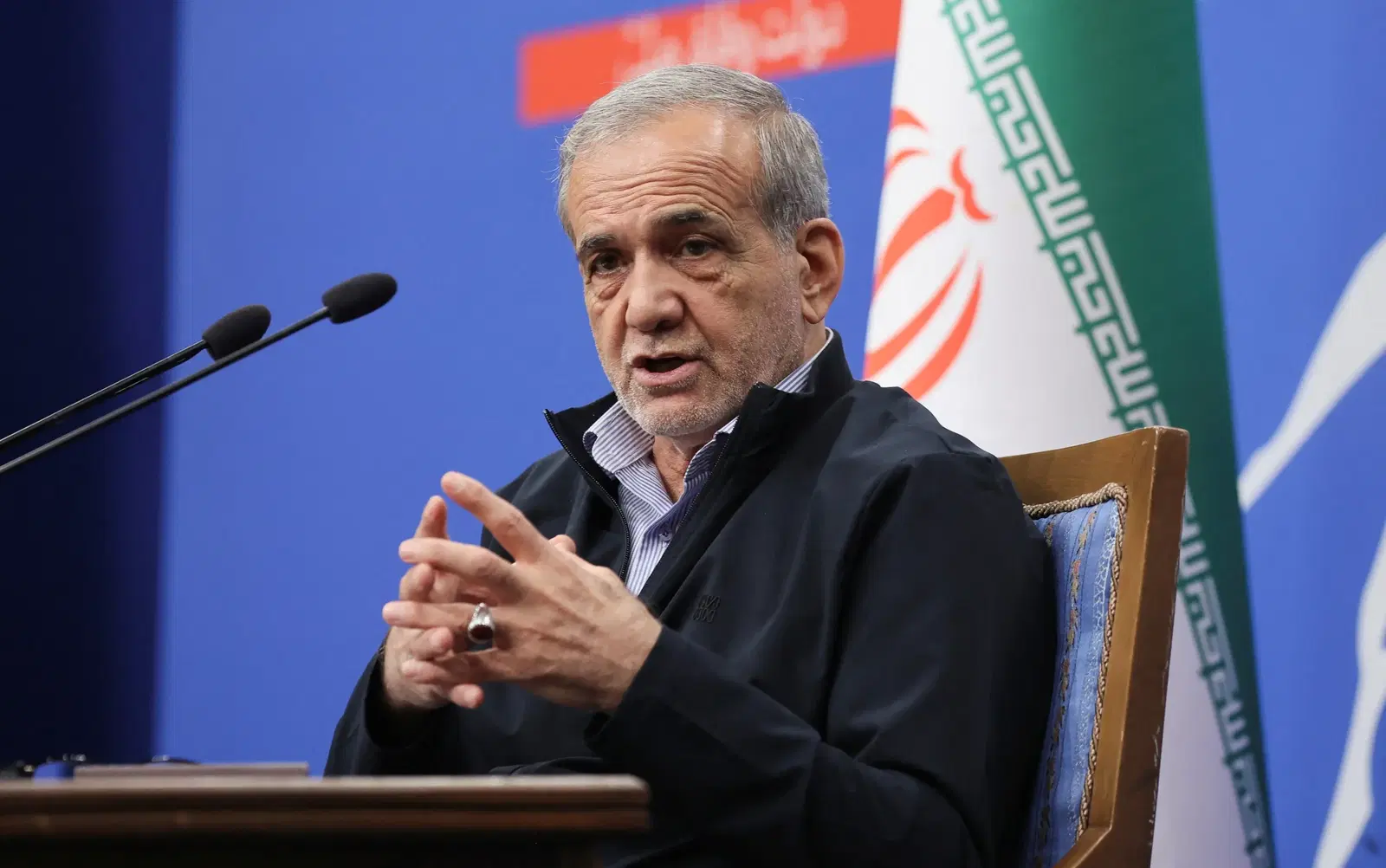
Tensions across the Middle East have surged dramatically as Iran’s president, Masoud Pezeshkian, declared that Iran will never capitulate in the face of threats from the United States and its allies. His statement came after Donald Trump publicly demanded what he called an “unconditional surrender” from Tehran, intensifying already volatile rhetoric as the regional conflict enters its second week.
The crisis has rapidly expanded beyond isolated confrontations, evolving into a wider regional confrontation involving multiple actors, strategic military bases, and critical energy infrastructure. Drone strikes, ballistic missile launches, and retaliatory air raids have created a tense and unpredictable environment stretching from Israel to the Persian Gulf.
Iran Rejects Pressure from Washington
President Pezeshkian delivered a firm message during a national address, stating that Iran would never bow to foreign pressure. According to him, Iran’s military operations are defensive and aimed at deterring what Tehran describes as aggression initiated by the United States and Israel.
His remarks were a direct response to President Trump’s statement calling for Iran’s unconditional surrender, a phrase loaded with historical weight and rarely used in modern diplomatic disputes. In geopolitical language, such demands typically signal an escalation beyond negotiation toward coercion.
Pezeshkian pushed back against the claim that Iran had already yielded influence in the region. Trump suggested that Iran had effectively “surrendered” to neighboring states after Tehran indicated it would not target regional countries unless attacks against Iran were launched from their territory.
Iran’s leadership framed that position not as surrender but as a warning. In simple terms, Tehran is drawing a line. Regional countries are not considered enemies unless they allow their territory to be used as launchpads for attacks on Iran.
IRGC Issues Stark Warning
The tone sharpened further when the powerful Islamic Revolutionary Guard Corps, commonly known as the IRGC, released its own warning.
The IRGC announced that if military strikes against Iran continue, all United States and Israeli military bases in the region would be treated as “primary targets.” This statement dramatically raises the stakes. The Middle East hosts numerous American bases and strategic installations spread across countries such as Iraq, Kuwait, Qatar, and Bahrain. Many of these facilities are vital to U.S. military logistics and intelligence operations.
From a strategic perspective, the IRGC’s warning signals an attempt to expand the cost of any continued offensive campaign. Military strategists often call this deterrence by escalation. The idea is straightforward. If the price of attacking Iran becomes too high for multiple countries, adversaries may hesitate before intensifying operations.
Israeli Operations Expand into Lebanon
While the diplomatic and rhetorical battle intensifies, violence on the ground continues to spread.
At least forty one people were reported killed during Israeli air and ground raids on the Lebanese town of Nabi Chit, located in the eastern Bekaa Valley. The area lies within a region long associated with militant networks and strategic supply routes.
Israel has not released full operational details, but analysts believe the strikes were aimed at disrupting weapons transfers and militant infrastructure believed to support Iranian aligned groups operating along Israel’s northern border.
The Bekaa Valley has historically been a sensitive zone in regional conflicts due to its geography. Nestled between mountain ranges and close to Syria, it serves as a corridor connecting multiple political and military actors. Whenever tensions rise between Israel and Iranian backed forces, the valley often becomes a flashpoint.
Saudi Arabia Intercepts Incoming Missiles
The conflict is no longer confined to Israel and Lebanon.
Saudi Arabia reported that its air defense systems intercepted two ballistic missiles aimed at the Prince Sultan Airbase, one of the kingdom’s most important military facilities.
Saudi authorities also said they destroyed drones that were heading toward the Shaybah oilfield, a major petroleum installation near the Saudi United Arab Emirates border. The Shaybah facility is considered strategically important because it contributes significantly to Saudi crude oil production.
Intercepting both ballistic missiles and drones suggests a layered attack strategy. Drones are often used either as surveillance tools or as precision strike weapons that can slip through radar coverage. Ballistic missiles, on the other hand, travel at high speeds and are designed to overwhelm defensive systems.
The combination of both indicates a coordinated effort to challenge air defense networks.
A Region on Edge
The wider Middle East now sits on a razor’s edge. Military analysts warn that when conflicts begin to involve multiple states, proxy groups, and critical infrastructure, escalation can become extremely difficult to control.
Energy markets are watching closely. Oil routes through the Persian Gulf remain among the most important in the world. Any prolonged conflict that threatens shipping lanes or production facilities could ripple through the global economy.
At the same time, civilian populations across the region are paying the price. Casualty numbers continue to climb as air raids, missile strikes, and drone attacks intensify.
Political rhetoric has also hardened on all sides. Leaders are speaking less about negotiation and more about retaliation and deterrence. History shows that once conflicts reach this stage, diplomatic off ramps become harder to construct.
For now, the region remains locked in a dangerous cycle of strike and counterstrike. Each new attack risks pulling more countries into the confrontation, transforming what began as a limited conflict into a broader regional war.
Observers and humanitarian organizations are urging restraint, but on the ground, the tempo of military operations suggests that the crisis is far from over.