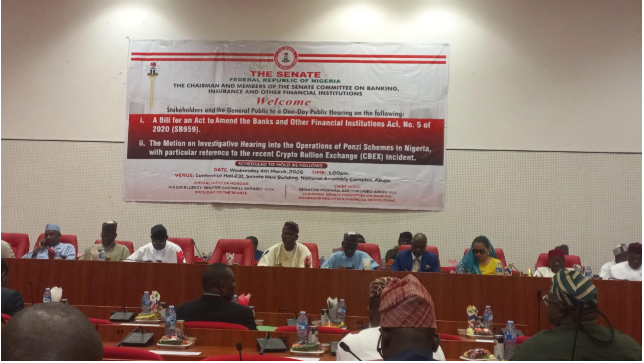
The Nigerian Senate on Wednesday, March 4, 2026, convened a high-stakes joint public hearing on the proposed amendment to the Banks and Other Financial Institutions Act (BOFIA) (SB959), alongside a sweeping investigative session into the controversial Crypto Bullion Exchange (CBEX) Ponzi scheme.
The hearing, led by the Senate Committee on Banking, Insurance and Other Financial Institutions, chaired by Senator Adetokunbo Abiru, was marked by explosive revelations from the Economic and Financial Crimes Commission (EFCC), sharp regulatory disagreements among federal agencies, and a determined push by lawmakers to recalibrate Nigeria’s fast-growing fintech ecosystem.
At the core of the deliberations was the disclosure of an estimated ₦1.3 trillion fraud linked to CBEX, a development that lawmakers described as a wake-up call for urgent legislative reform.
₦1.3 trillion CBEX scandal: “Figures not backed by value”
Delivering what many described as the most chilling testimony of the day, EFCC representative Dwain White exposed the inner workings of the CBEX operation, which allegedly promised unsuspecting Nigerians a 100 per cent return on investment (ROI) through so‑called “AI trading”.
According to the EFCC:
- Scale of loss: An estimated ₦1.3 trillion in total losses, with over $46 million already traced via blockchain analysis.
- Operational modus: Victims were instructed to purchase USDT (a stablecoin) on Bybit and transfer the funds into private wallets, effectively bypassing traditional banking red flags.
- Deceptive legitimacy: CBEX reportedly obtained a Special Control Unit Against Money Laundering (SCUML) certificate from the EFCC and used it as a false “badge of clearance” to deceive victims.
The anti‑graft agency revealed that more than 1,200 victims have already been identified in Lagos and Ogun states alone, describing the syndicate as having South‑East Asian links.
White emphasised that the platform’s financial representations were “figures not backed by value”, warning that digital sophistication is increasingly being weaponised against financially vulnerable citizens.
Regulatory war: agencies clash over jurisdiction
Beyond the CBEX revelations, the hearing exposed deep‑seated tensions among regulators over how Nigeria’s fintech sector should be governed under the amended BOFIA. A key flashpoint was the proposal to establish a Fintechs and Innovation Coordination Committee (FICC).
The Federal Competition and Consumer Protection Commission (FCCPC), through its representative Mr Ondaje Ijagwu, cautioned against creating what he described as a “parallel enforcement architecture”, arguing that aspects of competition law already fall within the FCCPC’s mandate.
The Nigerian Communications Commission (NCC), represented by Tanko, raised concerns over “dual regulation”, insisting that while the Central Bank of Nigeria regulates financial flows, the NCC must remain the sole regulator of telecoms infrastructure, the “pipe” through which digital transactions pass.
The Chartered Institute of Bankers of Nigeria (CIBN), led by Dr Bayo Olugbemi, strongly opposed Section 62G of the bill, which would grant the Central Bank “backdoor access” to banking algorithms. He described the proposal as a “massive cybersecurity hole” and an infringement on intellectual property rights.
Lawmakers react
Chairman of the Senate Banking Committee, Senator Adetokunbo Abiru, underscored the urgency of reform.
“The laws we have currently are yet to keep pace with the scale and systemic relevance of fintechs. This bill does not stifle innovation; it safeguards it. To the promoters of these schemes: your time is up.”
Senator Opeyemi Bamidele, representing the Senate President, opposed the creation of a standalone fintech body.
“Establishing a new body would duplicate existing functions and create bureaucratic overlap. Integration into BOFIA prevents the creation of a regulatory silo.”
In a separate intervention, Senator Victor Umeh raised concerns over the use of digital banking platforms in criminal activities, particularly kidnapping and fraud.
“When people use your app to receive money from kidnappers, is there no way we can track you? Can’t you lead investigators to where the money is?”
CBN’s defence: special resolution regime and behavioural analytics
Responding to concerns, Deputy Governor of the Central Bank of Nigeria (CBN), Mr Philip Ikeazor, explained that the amendment introduces a “special resolution regime”.
“This would allow the CBN to bypass judicial bottlenecks that previously allowed bank directors to obtain injunctions even when a bank was distressed,” he said.
CBN’s Director of IT, Rekiya Mohammed, added that the apex bank has transitioned towards advanced behavioural analytics.
“We are now able to see patterns where thousands of individual accounts are sending small, structured amounts to a single cluster. This is the classic signature of a Ponzi ‘collection’ phase.”
Private sector and civil society interventions
Managing Director of Moniepoint MFB, Babatunde Olofin, blamed part of the fraud crisis on identity misuse.
“Lack of education has made people sell their identity. They give their account details to fraudsters for ‘palliatives’. You trace them to somebody who sold his identity unknowingly.”
Ade Atobatele, CEO of Legishield Ltd, advocated stronger consumer protection measures.
“Sixty million Nigerians use electronic payments daily. When fraud hits their accounts, they have no automatic right to restoration. The EU gave their citizens that right in 2018; it is up to you to do so now.”
Key recommendations and next steps
Concluding the session, Senator Abiru announced the immediate formation of a technical committee to harmonise conflicting provisions of the BOFIA amendment, particularly concerning the jurisdictions of the NCC and FCCPC.
The Senate signalled its intention to produce what lawmakers described as a “living document” – one capable of protecting depositors while preserving Nigeria’s reputation as Africa’s fintech “proof of concept”.
Stakeholder recommendations included:
- CIBN: Establishment of a banking ombudsman or tribunal to resolve regulatory disputes swiftly.
- EFCC: Criminal liability for deceptive promotion of unlicensed investment schemes.
- NIRSAL: Mandatory physical presence for fintech companies across all geopolitical zones to enhance complaint resolution and agricultural de‑risking.
- NDIC: Increased public advocacy distinguishing insured from uninsured institutions to curb patronage of so‑called “wonder banks”.
- Moniepoint: Commitment to open 10 physical branches by the end of 2026 and expand nationwide coverage by 2028.
As deliberations continue, the Senate’s twin‑track approach – tightening statutory oversight while confronting the ₦1.3 trillion crypto scandal – signals a defining moment for Nigeria’s digital financial future.
About The Author