

AI
LAGOS, NG — The global race for space dominance in 2026 is no longer just about rockets and fuel; it is now a critical competition in Artificial Intelligence (AI) and breakthrough neural networks. As space agencies and private space firms push the boundaries of exploration, a silent technological “audit” is underway. Those with the most advanced deep learning capabilities are taking the lead, effectively merging machine intelligence with the final frontier.
The Intelligence Core: A New Space Race Engine
For decades, space missions relied on pre-programmed instructions and delayed communications with mission control on Earth. However, the 2026 space rush demands instantaneous, real-time decision-making.
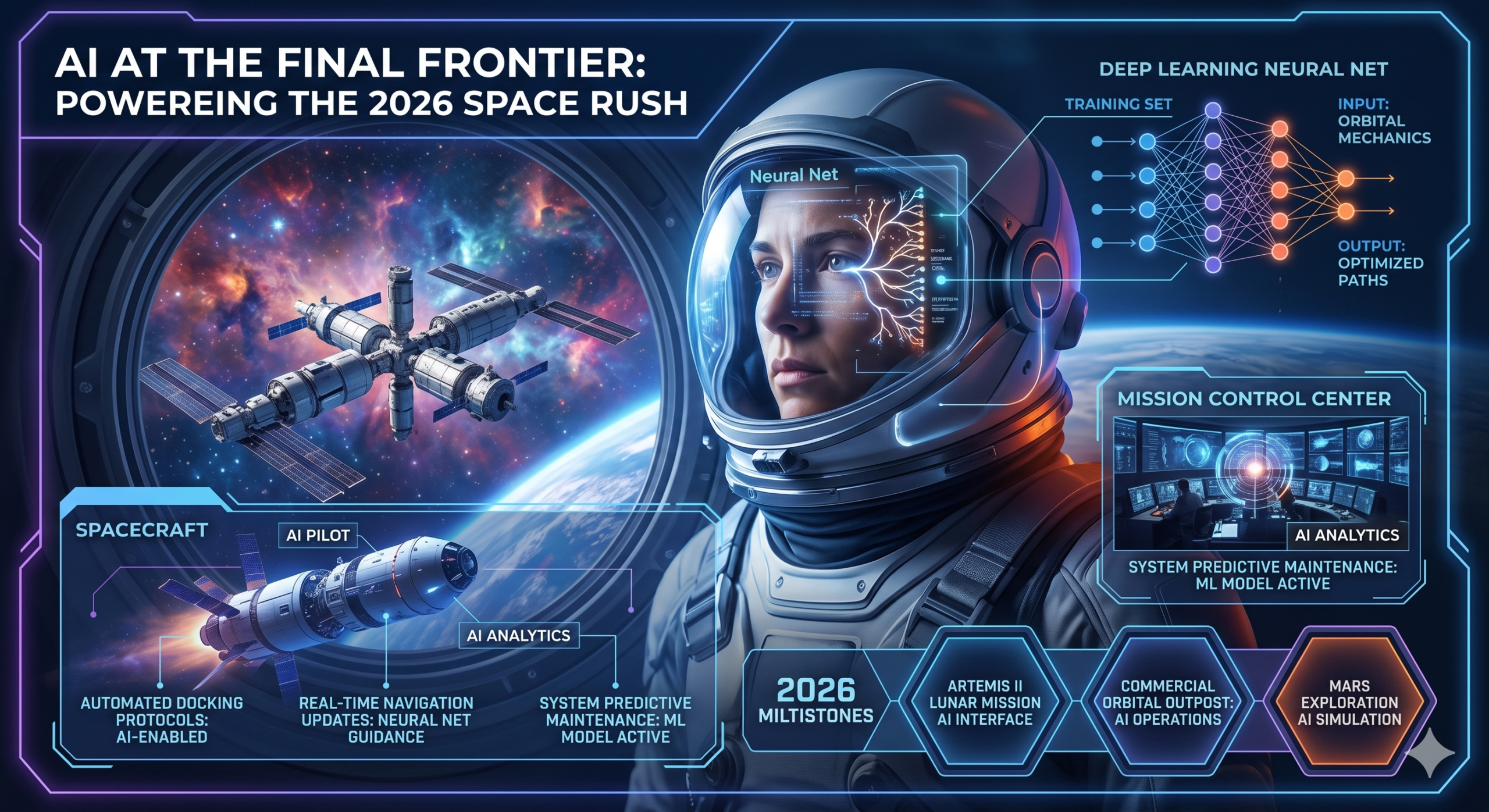
This is where the new Neural Net Pilot (as visualized above) is making its mark. Private and public space endeavors are now integrating adaptive AI algorithms that function as deep learning neural nets, analyzing massive, streaming orbital mechanics data directly from spacecraft. The input—raw, complex physics—is fed into multi-layered processing units, which generate optimized outputs, such as trajectory adjustments and life-support efficiency updates.
Automating the Unknown
The deployment of these neural networks is revolutionizing orbital operations. We are seeing a new era where:
- AI Analytics are utilized for predictive maintenance, anticipating component failures long before they occur.
- Neural Net Pilots enable automated docking protocols that are faster, safer, and more precise than any manual operation.
- Machine Learning models optimize real-time navigation, allowing deep-space explorers to chart new courses around newly detected space debris or gravitational anomalies.
Nigeria’s Tech Audit: Beyond the Horizon
This international acceleration has significant implications for emerging digital economies like Nigeria. While we are not yet launching our own crews, our tech ecosystem is perfectly positioned to provide the sub-systems that support this intelligence-driven frontier.
The core of this revolution is software and algorithmic power. As we transition from simple digital infrastructure to complex Machine Learning and Neural Networks, Nigeria can participate in the data analytics and software development sectors that are vital to these missions.
The Verdict: AI is the Compass of 2026
The integration of neural networks into space exploration is not just a passing trend; it is the definitive technological standard. The “audit” of space technology in 2026 has concluded that intelligence, not just thrust, is the compass guiding us toward the future. The data generated in orbit, processed by AI, will refine terrestrial industries, from finance to medicine. For the forward-thinking digital entrepreneur, understanding the synergy of AI and space is the next “lively storytelling” that matters.