
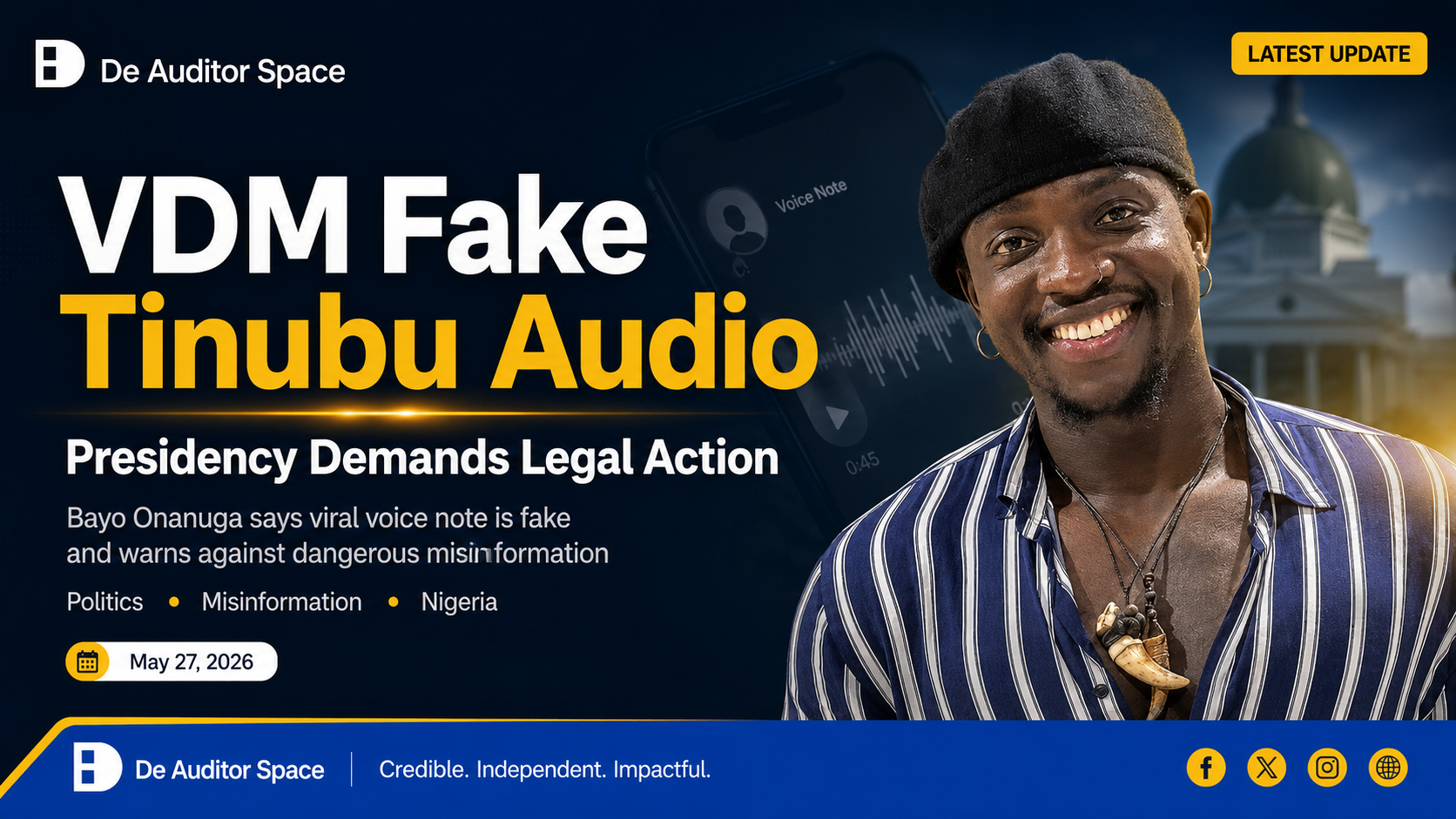
featured image with VDM
VDM fake Tinubu audio controversy don enter another serious level.
This one no be ordinary social media cruise again. The Presidency has now reacted, and the message is clear: fake political content can threaten public peace, especially when it touches insecurity, elections, and the South-East.
What Happened
A viral video and graphic circulating online accused social media influencer Martins Vincent Otse, popularly known as VeryDarkMan or VDM, of circulating an alleged fake audio linked to President Bola Ahmed Tinubu.
The attached Sahara Reporters-branded graphic carries the headline:
“VDM must face law for circulating ‘fake’ Tinubu audio, threatening insecurity in South-East.”
The screenshot inside the graphic shows a TikTok-style video with text claiming that a “Tinubu leaked voice note” came from an ex-APC senator and that Tinubu allegedly called Peter Obi to step down for him.
However, the Presidency has described the audio as fake.
Presidency Reacts Through Bayo Onanuga
On Wednesday, May 27, 2026, Leadership Newspaper reported that the Presidency said VDM should face the law over the circulation of the alleged fake audio involving President Tinubu.
The reaction came from Bayo Onanuga, Special Adviser to the President on Information and Strategy.
Onanuga also made the same point on X, where he accused VDM of being the conveyor and disseminator of a fake audio of President Tinubu. He described the matter as an abuse of social media.
According to Leadership, Onanuga reacted after an X user questioned why some people believed the voice in the audio belonged to Tinubu. The same user reportedly described the audio as “cheap propaganda” and accused VDM of using emotion to spread misinformation.
The Raw Facts / What We Know So Far
Here are the confirmed details from available reports:
- The controversy involves a viral audio allegedly linked to President Bola Tinubu.
- The audio reportedly claimed Tinubu contacted Peter Obi to step down for him.
- The Presidency has described the audio as fake.
- Bayo Onanuga, Special Adviser to the President on Information and Strategy, called for VDM to face the law.
- Leadership Newspaper reported the story on Wednesday, May 27, 2026.
- At the time of this report, no credible evidence has confirmed that the audio is truly President Tinubu’s voice.
- Also, no verified forensic audio report has been publicly released in the sources reviewed.
So, the safest and most factual position is this: the audio is alleged, the Presidency calls it fake, and the matter has now become a public misinformation and legal accountability issue.
Why the South-East Angle Is Serious
This matter became more sensitive because the attached graphic links the audio controversy to insecurity in the South-East.
That region has suffered enough from political tension, sit-at-home fear, killings, armed attacks, propaganda, and public distrust.
Therefore, any fake audio that claims the President said something politically dangerous can create panic. It can also fuel anger, deepen ethnic suspicion, and mislead people who may not verify before reacting.
This is why political misinformation is not small.
One fake audio can move faster than police clarification.
One edited clip can damage public trust.
One careless influencer can push millions into confusion.
Also, one viral lie can become street tension if people believe it too quickly.
Where Can You Download the Audio?
As of this report, I did not find any verified official download source for the alleged audio.
The safest references available now are:
- Bayo Onanuga’s X post, where he called the audio fake.
- Leadership Newspaper’s report on the Presidency’s reaction.
- The original social media post or video where VDM allegedly shared or reacted to the audio, if still available on his verified page.
However, De Auditor Space should not host or provide a direct download of an unverified or allegedly fake audio unless it is needed strictly for fact-checking, legal reporting, or forensic review.
Why?
Because reposting the audio can spread the same misinformation the report is warning against.
The better approach is to reference it, describe the claim, and link readers to verified reports or official reactions.
Why This Case Should Not Be Treated Like Cruise
Many Nigerians now treat social media as if it is just comedy.
But politics is different.
Security is different.
A voice note claiming to involve a sitting president is not the same as ordinary gossip. If the audio is fake, it can mislead citizens. If it is real, it should be verified with proper evidence.
Either way, the public deserves truth.
That is why influencers with large platforms must be more careful. When millions of people follow you, your mistakes can become national confusion.
VDM’s Influence and the Responsibility Question
VDM has built a massive online following by calling out people, reacting to controversies, and speaking boldly on public issues.
But influence comes with responsibility.
If an ordinary person shares fake content, the damage may stay small. But when a major influencer shares it, the damage can go national.
That is the problem here.
This is not about whether people like VDM or hate him. It is about whether influential voices should verify dangerous political content before sharing it.
What Security Agencies Should Do
If the government believes the audio is fake and harmful, security agencies should handle the matter properly.
They should not act with emotion.
They should:
- Identify the original source of the audio.
- Run forensic checks on the voice note.
- Confirm who edited or created it.
- Trace the first major accounts that amplified it.
- Invite relevant persons for questioning where necessary.
- Publish clear findings so Nigerians can know the truth.
Also, the government must avoid selective justice. If it goes after one influencer, it must also act against political actors and government supporters who spread fake news.
Truth must not have party card.
Way Forward
First, Nigerians must stop forwarding political voice notes without checking.
Second, influencers must treat national security content with care.
Third, media houses should avoid turning unverified audio into headlines without forensic context.
Fourth, government must respond fast to deepfakes, fake audios, and manipulated videos.
Finally, social platforms should improve detection of AI-generated political content, especially during sensitive periods.
De Auditor’s Bitter Truth
De Auditor has spoken.
The bitter truth is this: Nigeria is sitting on a dangerous misinformation time bomb.
Today, it is fake Tinubu audio.
Tomorrow, it may be fake Peter Obi audio.
Next tomorrow, it may be fake military order.
Then one day, people may act on lies before truth can catch up.
That is how countries enter crisis.
VDM must understand that boldness is not evidence. Noise is not truth. Going viral is not the same as being correct.
At the same time, the Presidency must also understand that fighting fake news requires trust. If citizens already distrust government, they may believe fake content faster than official statements.
So, both sides have work to do.
Influencers must verify before posting.
Government must communicate with evidence.
Citizens must think before sharing.
Because in a fragile country like Nigeria, fake audio is not just content. It can become fire.
De Auditors, Over to You
De Auditors, wetin una think?
Should influencers who circulate fake political audio face legal consequences, or should government focus more on tracing the original creator?
Drop your honest opinion in the comment section. Let us discuss this with facts, not blind loyalty.
#VDMFakeTinubuAudio #VeryDarkMan #Tinubu #BayoOnanuga #FakeNews #NigeriaPolitics #SouthEast #DeAuditorSpace #TruthDelivered
Ideas Audited. Truth Delivered.